Sid’s next letter arrives in June, with the news that he won’t get away to Buffalo as soon as he had hoped. Life was very busy and it seemed he wouldn’t be heading towards Elsie until after he taught summer school at Rutgers. It was probably not welcome news to Elsie, especially when Sid didn’t exactly express much regret about the situation, but maybe Elsie was also a bit impressed with Sid’s new – if temporary – position of authority. You can feel a bit of feather-fluffing as Sid describes his responsibility as Acting Head of the Psychology Department. I so wish we had Elsie’s response to Sid’s news, but as usual we still have to wait before Elsie’s voice speaks up from history.
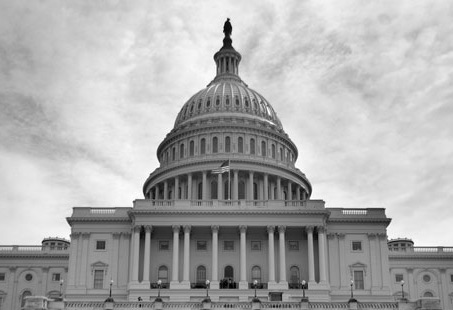
The voices that do speak out loud and clear from this letter are the ones that are still speaking loudly in Washington DC. Sid tells Elsie about a quick trip he had taken to Washington DC and a visit to the Capital Building. His reaction to what he saw and heard sounds awfully familiar. Eighty five years later, Congress is still full of men (and, thank goodness, now more and more women) talking for the sake of talking and very few people actually good at listening.
With shutdowns, investigations, immigration and talk of impeachment filling the news in 2019, I wondered what was on the agenda in Washington DC in 1932. Obviously this was during the Depression, my grandfather mentions the troubled times in the country and how those troubles didn’t seem apparent from what he saw in the Capitol Building, but I wondered if the government was working any more smoothly back then, so I looked up the congressional record, or at least a summery of it, for the spring of 1932. I may not have read all the details, but it is clear that some things in Washington haven’t changed that much. In 1932 the Democrats and the Republicans were busy proposing various solutions to the deep crisis the country was facing, and President Hoover was busy vetoing many of them. On the surface it looks a lot like Washington in 2019. But unlike today’s incredible mess, the folks in Washington in 1932 were actually getting things accomplished. Compromises were being made and bills were being passed. I am struck by the magnitude of the crises then, how many millions of Americans were on the brink of disaster, how high tensions must have been running. People must have felt very strongly about what should be done, and yet there seems to have been a basic civility (or sense of civic duty) that guided the governing processes, that made compromise, even in the hardest of times, possible. The challenges of today may provoke equally passionate responses, but where and why in 2019 have we lost that ability to accept that compromise is usually part of the solution? When did we let go of the idea that working for the greater good may mean accepting solutions you don’t love? How do we change compromise from being a pejorative back to a quality we respect?
And yet I am under no illusion that the Washington DC of 1932 was ideal. It was far from it. In 1932 it was a white man’s game, and when white men decided the future for the country, when white men spoke as the voice of all Americans, millions were silenced and excluded. The vast diversity of this country were speaking up, movements for equality were underway – women had finally achieved the vote – but positions of power were still only available for the select few. The elections of 2019 show how far we have come in very recent times towards changing the face of Washington. There are still an awful lot of white men in the seats of power, but at least we can see that the tide is starting to change.
It’s funny. When we think of the past – the recent past, like when our grandparents were young – we tend to fall into two camps: either “Oh, the good old days!” or “Look how far we have come since then!” It is clearly not that simple though. When you dive in and look more closely at history, like through the lens of these letters, you discover that both can be simultaneously true. Politics and social commentary are a thread that run through all my grandparents’ letters. At times it all seems so familiar – nothing much has changed as politicians posture and preach – but then one is brought up short by a comment, a theory or even the choice of words themselves, and you realize that many of us have traveled miles since 1932.
Anyways, I’ll stop preaching (for now) and let you enjoy the letter.
June 11, 1932
Dear Elsie,
Long before this I had hoped that I could write that I was coming to Buffalo for two or three weeks before the start of summer school. As a matter of fact my formal college duties finished on May 28th when I handed in the results of the last examination. And today commencement marks ‘finis’ to the college year. Unfortunately there seem to be perfectly good reasons why I should stay here. The head of the dept. sailed for England on May 17th and since that time I have been in charge; no very important matters have arisen nor have I been faced with any weighty decisions but one never knows what may happen. Anyway it was better policy to be on deck, and especially for Commencement which is to be quite an affair with the inauguration of a new president. So many have been in the habit of skipping this affair in the past that they will probably check off the attendance this year. At least we have a “break” for the weather is ideal – cool and clear – for an outdoor affair, while all the other Commencements that I have attended (as few as possible) have been sweltering in mid-summer weather. So far in June we have had samples of all kinds, but I can assure you a summer like today would be fine. This is the kind of day we have at the island – warm enough at noon, but a snap in the air in the morning and evening.
I suppose that with the approach on June you begin to long for that place. When are you going up this year? You see I am assuming that all the snow has melted and that even in Buffalo spring is in the air! After waiting this long I may as well start my vacation after summer school as there is only a week between now and a week’s job at Penn and the beginning of summer school. So this week you can picture me as contemplating on what to give all the earnest seekers after knowledge who gather soon.
I excursioned to Washington a week or so ago to see Mt. Vernon, and in the morning watched both houses of Congress in session. No one would suspect that these are trying times in the history of this country. In the Senate one man was making an impassioned speech to – well, either the Congressional Record or the gallery, for none of the 7 or 8 Senators present evinced the slightest interest, some talked together, others read the paper or walked around chatting. It is always a revelation to see these people in action. The House was more active – but it was like a side-show. One sees there is a fine art of talking for talking’s sake. I saw some of the [Bonus?] marchers in the galleries, a rather seedy lot. Everybody just has the idea that the gov’t runs a dandy, big grab-bag and one has only to shout long enough to be allowed to dip into it. It seems that the aftermath of war that is more disturbing than war itself. However, we crawled up to the dome of the capital and forgot about all the little quarreling men inside as we surveyed the city stretched out for miles all around; I never before realized how many trees there were in the city. It was a grand sight!
From now on I suppose we shall hear only about the Presidential race. I wonder if Mr. H. [Hoover] would like another try at the job. His 4 years have been hectic ones, but I imagine he is anxious to show what he can do when given another chance.
Here I should close, and try to get it into the first mail, for I have delayed too long in answering. Never follow my example!
Sincerely,
Sid
 El and Sid ~ A Slow Romance